A daily current-affairs platform that turns the news cycle into something you can study from.
Headlines are abundant. Understanding isn’t.
Anyone preparing seriously for a competitive exam — or just trying to follow Indian policy properly — hits the same wall. The news is everywhere and the context is nowhere. You get the announcement without the mechanism, the verdict without the statute, the number without the base year. Reconstructing that yourself, every morning, across six subjects, is the actual work.
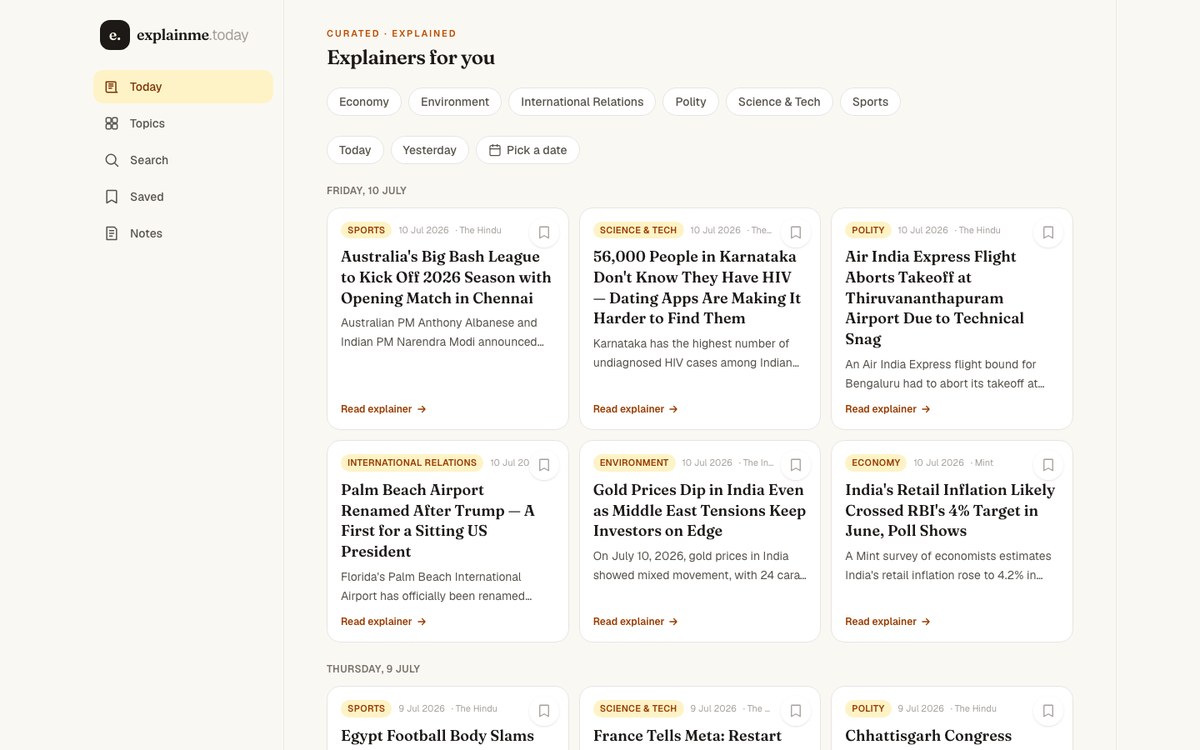
ExplainMe Today does that reconstruction once and publishes it. Each day’s stories are curated from the mainstream Indian press, sorted into the verticals a syllabus is actually organised around, and paired with an explainer that supplies the background the headline assumed you had.
An editorial pipeline with a reader on the end of it.
Date-first architecture
The primary axis is the day, not the feed. Readers browse by publication date, which matches how anyone revising actually works — catch up on what you missed, not scroll an infinite stream.
Six-vertical taxonomy
Economy, Environment, International Relations, Polity, Science & Tech, Sports. Fixed categories that map onto a syllabus rather than a newsroom’s internal desks.
Story → explainer pairing
Every curated item carries a longer explainer behind it. The summary tells you what happened; the explainer tells you why it can happen and what it changes.
Saved articles
A personal archive, because the value of a current-affairs item is realised weeks later during revision, not on the day it lands.
Notes
Reader notes attached to the material itself, so annotation lives with the source instead of in a separate notebook that drifts out of sync.
Search across the archive
Retrieval across everything published to date — the archive compounds in value, so it has to stay findable as it grows.
A daily product has no forgiving days.
- Publishing cadence is a system constraint, not a content one. Anything that makes the daily pass slower eventually makes the daily pass optional — so the editorial path was built to be fast before it was built to be clever.
- Curation is sourced from established mainstream publications. Provenance matters more than volume when readers are studying from the output.
- The taxonomy is fixed and small. Six verticals that never change beat a growing tag cloud, because the reader’s mental model has to survive a year of daily use.
- Saving and note-taking sit in the free reading path. The retention loop for a study product is the archive a reader has built inside it.
Content that has to ship every day?
Editorial pipelines, publishing tooling, archives that stay searchable as they grow. Tell us what you’re running.
Talk to us