A law that assumes a record nobody was keeping.
The ART (Regulation) Act 2021 and its 2022 Rules ask an Indian fertility centre to prove things about events that happened months or years earlier — who consented to what and when, which gametes came from which donor, how long a straw has been in storage, what was filed and by which deadline. The obligation is continuous; the evidence is usually assembled at inspection time from registers, folders and a spreadsheet.
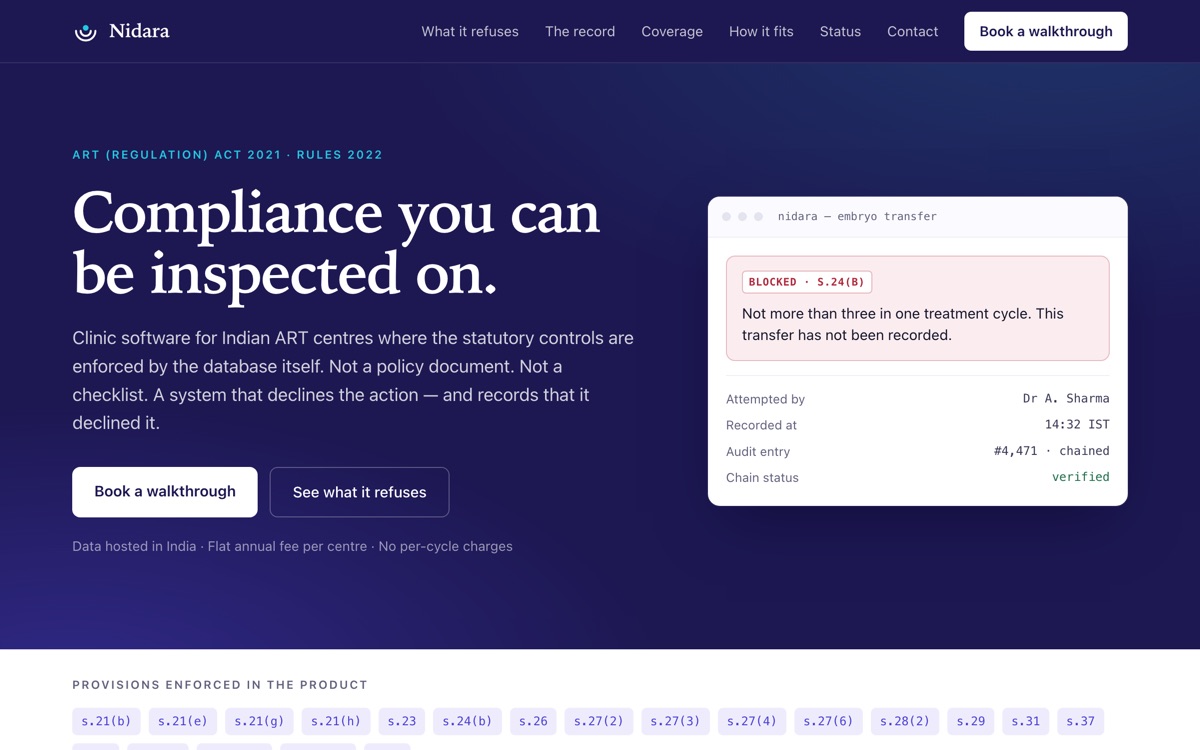
Software normally treats compliance as a reporting layer — do the work, then produce a return that describes it. That is backwards when the statute constrains the work itself. Nidara puts the rule where the record is written: the action that would breach the Act does not complete, and the attempt is kept. The result is a centre that is ready to be audited on any given day, rather than one assembling its evidence after an inspection is announced.
The whole clinic on one audited record.
Not a lab module bolted to an existing practice system. Patient journey, front desk, operations and the embryology lab write to the same append-only ledger, because a custody chain that starts at the lab door cannot answer where the consent was taken.
Statutory controls in the schema
Twenty-one provisions of the Act and Rules are enforced as database constraints and guarded functions — donor eligibility, the ten-year cryostorage clock and its extension, transfer-out, filing deadlines. A blocked action is recorded as a block, so the refusal itself is evidence.
Append-only event chain
Every custody event is hashed into a chain that cannot be rewritten without the break showing. An inspector’s question is not “what does the system say now” but “what did it say then”, and only an immutable record answers that.
Specimen custody and witnessing
Barcode identity from retrieval through culture, freeze and transfer, with witnessing captured at the step rather than reconstructed after it. The barcode and QR encoders are verified by decoding our own output back, module by module, against a reference.
Consent register
Versioned templates with the consent text frozen at the moment of signing, plus legal hold and recorded refusals. Consent that silently follows a template revision is not consent to the thing that was signed.
Registry filing and evidence packs
Monthly returns computed from the record rather than keyed into a portal, against the Rules’ deadline, and inspection packs assembled from the same source. Nothing is typed twice, so nothing can disagree with itself.
Multi-centre, with residency
Branch and tenant isolation enforced at the row level, permissions resolved per user rather than per screen, and the data held in India — a fixed-at-creation decision, because residency is not a setting you change later.
A declared control is decorative until you watch it work.
- Several controls we had declared did nothing when exercised — a rule that read a column no path ever wrote, a guarded function any tenant could call. Each was found by running the rule as a real user, not by reading the code. There are 31 verifiers for this reason, and they run as an authenticated user rather than as the owner of the database.
- Test the rule and the permission. A control that enforces the right constraint for the wrong person is still a finding, and the two failures look identical from the interface.
- Time is a compliance surface. The database runs on Asia/Kolkata so that a deadline means what a clinic thinks it means, while the integrity digest is pinned to UTC — anything session-dependent inside a hash makes the entire chain read as forged.
- Seats are unlimited by design. Per-seat pricing makes staff share logins, and a shared login destroys the audit trail the rest of the system exists to protect. It is a compliance decision wearing commercial clothes.
- Billing never gates care. The money module is opt-in and sits beside the clinical record rather than in front of it — a centre can run its own accounting stack and integrate, and no unpaid invoice can block a cycle step.
Onboarding its first centres, and saying so.
Nidara is a configurable base platform, customised per centre. It is being onboarded with its first centres in Bengaluru alongside clinical advisers, and we describe that as what it is rather than as a launch-partner programme. Centres make regulatory decisions on this material, so the claims on it stay capability claims.
nidara.inRunning a regulated operation on registers and folders?
Statutory deadlines, custody chains, consent that has to hold up years later. We build the systems that carry them — and the audit trail on day one, not in month six.
Talk to us